There is a budhist principle amplified by carrying your gear at altitude - The more possessions, the more you suffer. I enjoy this knowledge as much as the idea that tattoo removal hurts more than tattoos. Some pains are necessary.
Apart from being around 4000 metres above sea level, Lake Titicaca does a good impression of being an ocean. It's expletively big and even has seagulls.
The Inca's believed they originated from the lake and called it "The Womb of Mankind". Explorers, including Jacques Cousteau, had reason to think that it could be the resting place of Atlantis. Expeditions have discovered underwater roads and a temple. Incidentally, the lakes depths are the home of a rarely seen frog species up to 50cm long named Telmatobius coleus – the aquatic scrotum.
By boat, the tour group took a sizeable chunk of daylight to get to our destination, but we still had only navigated a fraction of the lake's length.
The journey was via a stop at the remarkable Uros Islands. What makes this place special is that they are floating islands artificially created from primarily one natural material - a reed that grows in the lake. Around 3 metres thickness of reed is woven together to create a new land for these people. This versatile reed is also eaten, used as fuel, medicine and for making boats and houses. When 3D printers become common, these islanders won't be impressed.
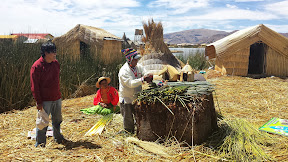
The original reason for these floating islands was defensive, whether the threat be pre-Incas, Incas or Spanish conquistadors. As the reeds rot they need to be replaced every 15 to 30 days depending on season. Where the thatch houses are concerned, they need to be lifted for this regular maintenance work. In the case of a neighbourly dispute that cannot be resolved, they cut through the "ground" and float off in different directions.

Our destination was the more terrestrial Amantani island. We were met by several Quechua-speaking local ladies in preparation for our home stay. The communication plan was a brief written list of phrases in the local tongue, the chance someone else in the family speaks Spanish, and the hope that 'smile and nod' doesn't lead to any irreversible weird shit.

From here, the tour group was divided up into pairs and then upland we followed the lady that was to be our "mama" for the next 24 hours. If this lady wants to be my mum, then she has a backlog of ordeals to catch up on. Let's begin with "Wipe me!"

At the humble, off-the-grid house, our room was shown, we presented some prior-purchased gifts (rice, sugar, oil etc) and the husband, grandma and 2ish year old daughter were introduced. A tasty late lunch of Quinoa soup and veges from the island was prepared. In my backpack, I still had a bag of toy soldiers, purchased at the mainland market. This was in anticipation of the family having a young boy (is that a believable cover story?). During the meal, the other temporarily adopted son made a paper crane for the interactive daughter. She identified it as "pato" meaning duck, then grabbed a knife from the table and proceeded to saw its head off. In this moment, I realised two things: 1 - this is a pretty authentic island living experience, and 2 - maybe she's ready for the plastic army men. As a bomber jet came out of the bag, I acknowledged that this could be a traumatic gift in a different part of the world. She loved them.
For sunset, we walked to one of the island's peaks. This mountain was dedicated to Pachamama, Mother Earth. Despite the extensive reach of the Catholic church across this continent (genocide has been a tad influentual), the cultures of the Andes still weave Pachamama into the worship.

Apart from being around 4000 metres above sea level, Lake Titicaca does a good impression of being an ocean. It's expletively big and even has seagulls.
The Inca's believed they originated from the lake and called it "The Womb of Mankind". Explorers, including Jacques Cousteau, had reason to think that it could be the resting place of Atlantis. Expeditions have discovered underwater roads and a temple. Incidentally, the lakes depths are the home of a rarely seen frog species up to 50cm long named Telmatobius coleus – the aquatic scrotum.
By boat, the tour group took a sizeable chunk of daylight to get to our destination, but we still had only navigated a fraction of the lake's length.
The journey was via a stop at the remarkable Uros Islands. What makes this place special is that they are floating islands artificially created from primarily one natural material - a reed that grows in the lake. Around 3 metres thickness of reed is woven together to create a new land for these people. This versatile reed is also eaten, used as fuel, medicine and for making boats and houses. When 3D printers become common, these islanders won't be impressed.

The original reason for these floating islands was defensive, whether the threat be pre-Incas, Incas or Spanish conquistadors. As the reeds rot they need to be replaced every 15 to 30 days depending on season. Where the thatch houses are concerned, they need to be lifted for this regular maintenance work. In the case of a neighbourly dispute that cannot be resolved, they cut through the "ground" and float off in different directions.

Our destination was the more terrestrial Amantani island. We were met by several Quechua-speaking local ladies in preparation for our home stay. The communication plan was a brief written list of phrases in the local tongue, the chance someone else in the family speaks Spanish, and the hope that 'smile and nod' doesn't lead to any irreversible weird shit.

From here, the tour group was divided up into pairs and then upland we followed the lady that was to be our "mama" for the next 24 hours. If this lady wants to be my mum, then she has a backlog of ordeals to catch up on. Let's begin with "Wipe me!"

At the humble, off-the-grid house, our room was shown, we presented some prior-purchased gifts (rice, sugar, oil etc) and the husband, grandma and 2ish year old daughter were introduced. A tasty late lunch of Quinoa soup and veges from the island was prepared. In my backpack, I still had a bag of toy soldiers, purchased at the mainland market. This was in anticipation of the family having a young boy (is that a believable cover story?). During the meal, the other temporarily adopted son made a paper crane for the interactive daughter. She identified it as "pato" meaning duck, then grabbed a knife from the table and proceeded to saw its head off. In this moment, I realised two things: 1 - this is a pretty authentic island living experience, and 2 - maybe she's ready for the plastic army men. As a bomber jet came out of the bag, I acknowledged that this could be a traumatic gift in a different part of the world. She loved them.
For sunset, we walked to one of the island's peaks. This mountain was dedicated to Pachamama, Mother Earth. Despite the extensive reach of the Catholic church across this continent (genocide has been a tad influentual), the cultures of the Andes still weave Pachamama into the worship.


